

I’m sick of seeing posts online calling Gen-Zs “snowflakes.” After all, calling us “thin-skinned” feels like a personal jab against our heightened awareness of mental health and social justice. For many of us, that awareness feels like a necessary evolution of empathy in a tumultuous world—not some mark of shame. But to play the Boomer’s advocate for a second, what if there’s some substance to these allegations?
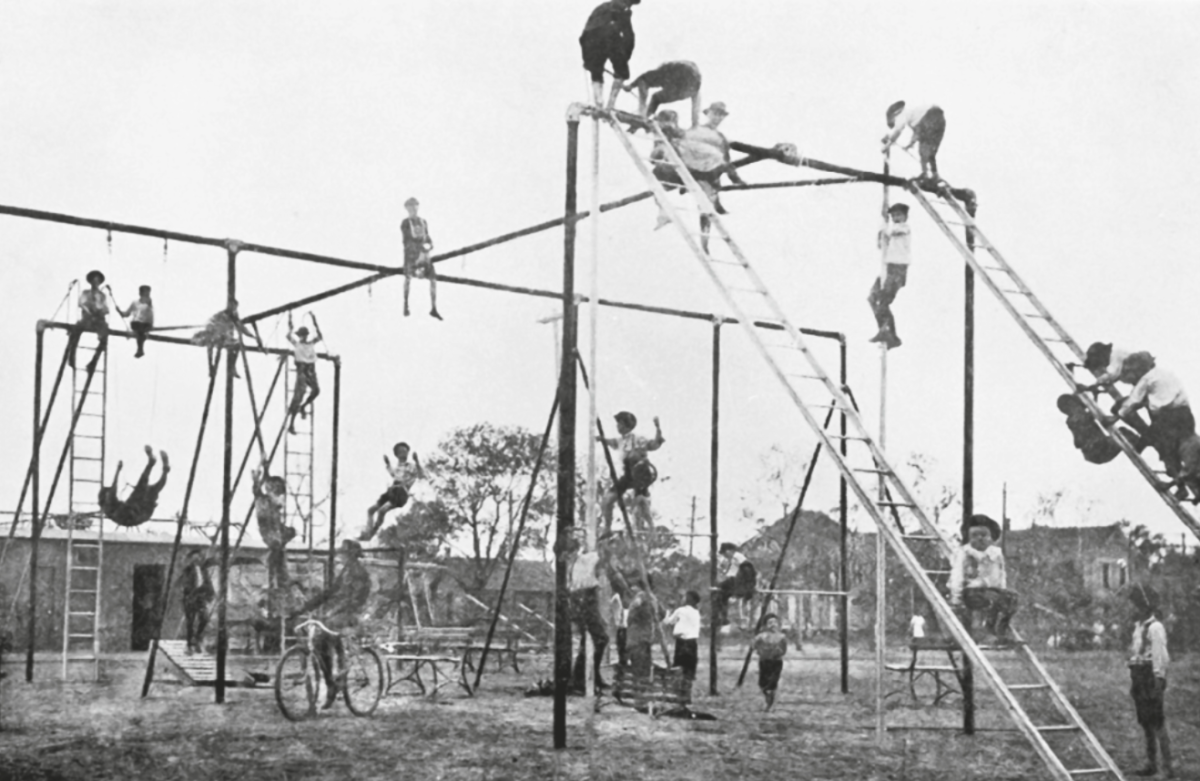
During the latter half of the 20th century, playgrounds experienced a steep decline in risk: asphalt gave way to cushioned rubber, towering metal structures were lowered, and equipment that carried any risk at all was promptly removed. The adults collectively decided that the world was, in fact, so saturated with dangers that children should not be able to explore it whatsoever. It is now quite difficult to hurt yourself on modern-day playgrounds—meaning that children are learning how to not get hurt even less.
Then, of course, there was the exponential growth of the “digital playground” at the turn of the century. Born into a world of front-facing cameras and Instagram, 21st-century babies have increasingly found presence in the alternate universe inside their back pockets. By the pandemic, when the whole physical world became briefly digitized, children didn’t need much convincing to stay indoors anymore.
The drastic difference between what childhoods looked like in years past and now are cited by American social psychologist and author of The Anxious Generation, Jonathan Haidt, as one of the factors contributing to the lack of antifragility—the quality of not just enduring adversity, but learning from it—in today’s youth. In his 2024 book, Haidt argues that modern “safetyism”—the impulse to shield children from every conceivable discomfort—has backfired, producing its opposite effect. After all, a generation that has grown up on padded playgrounds never learns how to fall. So, when the real world arrives at our doorstep, we may find ourselves faltering more than we wish to admit.
Joy:
For me, this faltering was less of a dramatic crash and more of a long-winded spiral of avoidance. I arrived at Mitty from my public middle school hoping for a clean reset—something more akin to the Disney Channel narrative rather than reality: new people meant that I could pursue a new, more effortlessly impressive me.
What followed was approximately three years of exhausting, performative, and very effort-ful behavior. There were times I genuinely felt like a video game NPC: pre-programmed dialogue options from my conversation rehearsals in the shower, the same hoodie-and-jeans outfit on rotation every week, and a chronic aversion to outwardly disagreeing with any given opinion that came my way. By my senior year, the cracks had long begun to show through the persona I’d curated.
My friend, to her credit, noticed I was miserable before I was fully able to admit it myself. Pointing out my lack of social life in the kindest way possible, she extended an invitation to join her out-of-school friends—which was really just a polite way of suggesting that I take on a side quest of going outside and touching some non-digitized grass. And, with some hesitation, I agreed.
Admittedly, it felt unmooring to deviate from my usual script, being thrown into a group of people that was unapologetically genuine in a way that was unfamiliar to me. But it was, against all reasonable expectations, really fun. I was dragged to karaoke and indulged in the public humiliation of displaying my hidden talent for singing off-key. I was also convinced to host a cooking competition that ended in blackened chicken breast and overcooked pasta. Somewhere along the way, I stopped talking to myself in the shower to rehearse conversations. I discovered the joy of “friendly fire”: apparently friendship often involves telling your friends to shut up occasionally—with boundless affection, of course. Taking risks opened my tastebuds to burned chicken and my ears to off-tune singing, but most importantly opened myself to being genuine to those around me.
Manvik:
It’s fair to say I had a very different pandemic experience from most people. While most people (rightfully) lamented being cooped up in their house all day, not being able to interact with people face to face, and the general lack of newness, I remember ecstatically exclaiming to my mother that “2020 was the best year of my life.” Despite being stuck at home, I didn’t feel like there was anything I lacked: I had my parents by my side, my friends were just a phone call away, and there were even “online fencing” classes to keep me engaged and physically fit. What was there not to like?
For once in my life, I could wake up 10 minutes before school started and attend class in my pajamas. And instead of having to meet an entirely new group of people in each class, I could comfortably talk (or Zoom chat) in class with my cohort of my peers. Far throw from the quiet child who rarely participated in class, I was thriving during online classes, constantly making jokes with my peers and talking to my teachers; one may even go as far to call me socially adept—can you imagine?
While the world grappled simultaneously with both the paralyzing uncertainty and crippling boredom of living through a pandemic, I lived in a sheltered cocoon—happy to simply stay in my comfort zone.
But the lockdown was eventually lifted, and life began returning to normal. The thing was, I couldn’t do “normal” anymore. Talking to new people again felt draining, and going outside felt like a risk. Long after restrictions were lifted, I clung to the protective cocoon of the pandemic. I’d wear my mask almost constantly throughout freshman and sophomore year—to the point where none of my friends knew what I looked like—and I’d take as many as three baths a day—because anything less would be like rolling out a “welcome” mat for those infected to cough all over. The pandemic hadn’t made me socially adept or happy; it had made me deathly afraid of taking risks.
Ironically enough, though—despite the constant masking, sanitization, and my penchant for long showers—I did get COVID. And after I recovered, I realized dismally I had no excuse left to give my parents as to why I needed to wear my mask anymore. Going to school the first day without my mask felt like stumbling through the dark. The thought of one, getting COVID again (don’t ask me how—it could happen); two, doing a face reveal worse than Dream’s; or three, not getting recognized by anyone, made taking off my mask a morbid risk.
But two years later, I’d have to say…it was one of the best risks I ever took. Taking off my mask—and not getting sick, not getting ridiculed (but rather even complimented), and getting recognized by my teachers even years down the line—showed me the importance of taking a chance. These days, it’s never easier to retreat into our little cocoons and stay there—scrolling through the same old feed made by the same old algorithm, talking to the same old people, and doing the same old things—but it’s also never been quite so important to take that risk, to try something different, or to talk to someone new.
Haidt is ultimately right, our lack of risk-taking has left us easily triggered, fragile, and fundamentally “anxious.” But take it from the guy who took a bath three times a day and the girl that talked to herself in the shower, we can become anything we want to be—if only we take one chance, if we take one risk. Because though risk represents the unknown, it also represents possibility. Because though talking to new people is hard, it represents new connection. And though we may be afraid now, if we confront that fear, we won’t be “anxious”—we’ll be “brave.”