

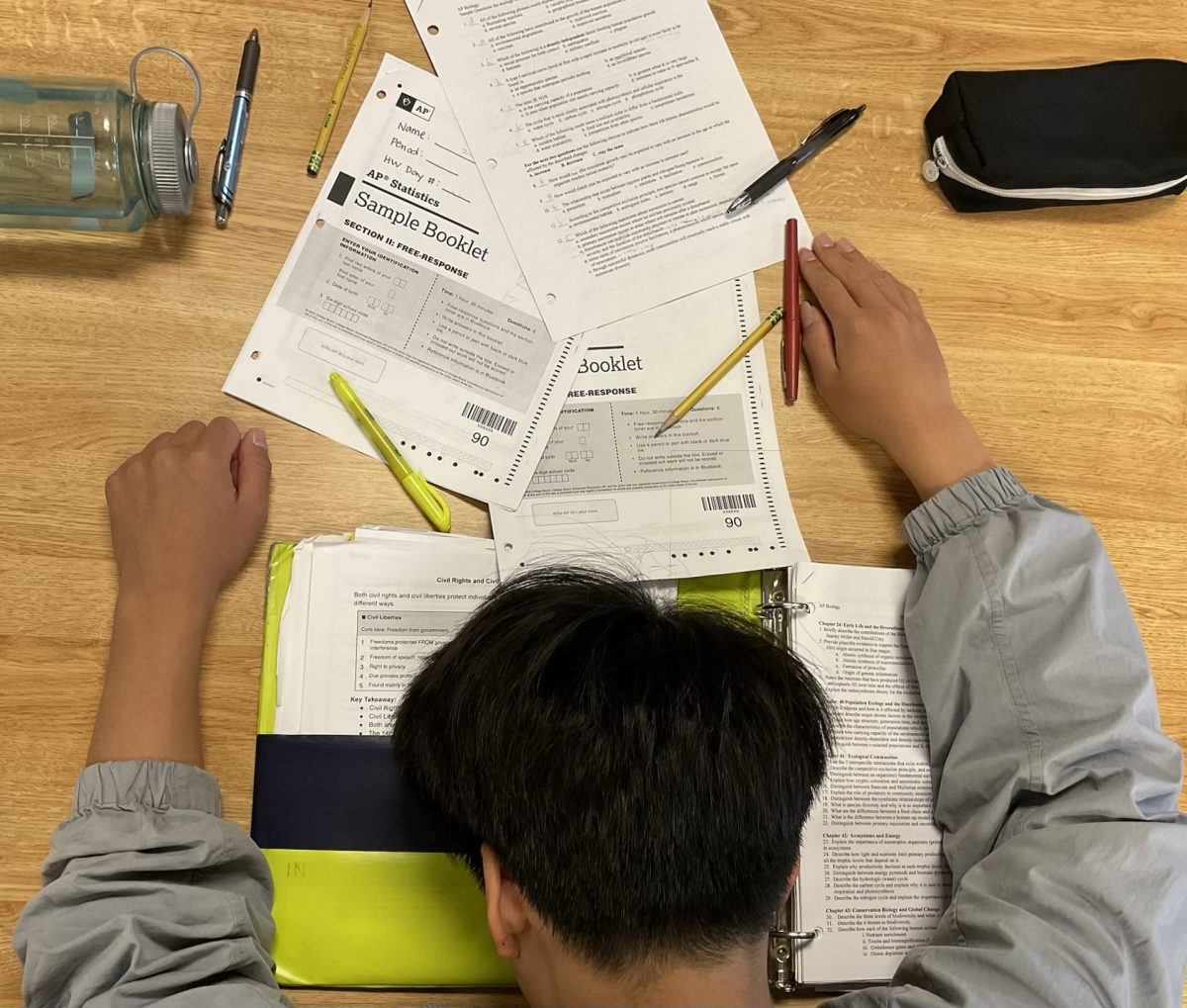
Listen up, Monarchs! The season has arrived. The long nights, overwhelming anxiety, and towers of books are finally here: AP exam season. But while the main purpose of these exams is to test students’ understanding of concepts, they reveal that important factors like pressure, mindset, and study habits all play a role in shaping test outcomes. Therefore, the AP season is more than just a frustrating one; it tests knowledge beyond the academic field, addressing how well students can adapt and grow.
In simple terms, AP (Advanced Placement) classes are college-level courses offered by high schools through the College Board. More rigorous than regular or honors classes, these courses are designed to match introductory college classes and provide a deeper understanding of subjects. Even when difficult, they also provide an academic advantage through weighted GPA boosts following a scale of 5.0, an extra 1.0 point.
The logistics of such a national exam system, with a total of 2,526 individual exams and 909 Mitty students taking them, are more chaotic than a physics problem, so organizers put a great deal of energy into planning it all. This year, Mrs. Tien Menor, a guidance counselor at Mitty, is in charge of organizing AP exams, and according to her, it can become a lot: “It takes a lot of planning. Is it like planning a wedding? That’s not fun. There’s no party.”
However, as Mrs. Menor states, handling this season isn’t a one-person job; many people across the school play a role in helping out. Campus assistants help, and counselors work together to organize extended time, which is why counselors are crucial during this season. Many of the proctors are retired individuals who volunteer their time to ensure that students can take their exams smoothly. And due to possible incidents, there are always extra staff available, prepared for someone to step in if something happens.
Different AP courses can also be very different in how they are taught and tested. For example, AP Music Theory, a course testing a student’s understanding of musical fundamentals like harmony, rhythm, and structure, includes both a traditional multiple-choice section and a unique performance component where students must go into individual rooms to complete a sight-singing portion; this often takes months of planning to get the right materials and proctors.
Just like how counselors have to plan for exam logistics, students have to plan around studying for exam content. Junior Maggie Cao ‘27 reflects on her experience taking AP U.S. History, which is typically reserved for upperclassmen in other schools, testing students’ knowledge of American history, focusing on historical thinking skills, document analysis, and argumentative writing. She stated, “I regret not studying early enough. I started studying only two weeks before, and I felt like I didn’t have a deep enough understanding of the topic during the test.” In contrast, junior Vincent Hsiao ‘27 speaks on his experience taking AP Music Theory. He remarked on how different this test is from conventional ones, for instance training aural skills and sight singing over conventional reading comprehension or calculations, “requiring a strong music background and hours of constant practice.” Every test is unique in its own way and requires different studying methods to understand the material.
As a result, AP season is understandably rough. That’s why students need to stay calm and focused throughout it: it is recommended to plan and create a realistic schedule while prioritizing rest and nutrition. Also, remember that you’re not alone. All the teachers, counselors, and proctors are there to support you every step of the way. It is also advisable to get plenty of rest, since mindset can matter just as much as knowledge when taking an exam. Lastly, keep an open perspective; one exam doesn’t define you, and taking care of your mental and emotional well-being is just as important as any score. So during this season, start where you are, use what you have, and do what you can.