

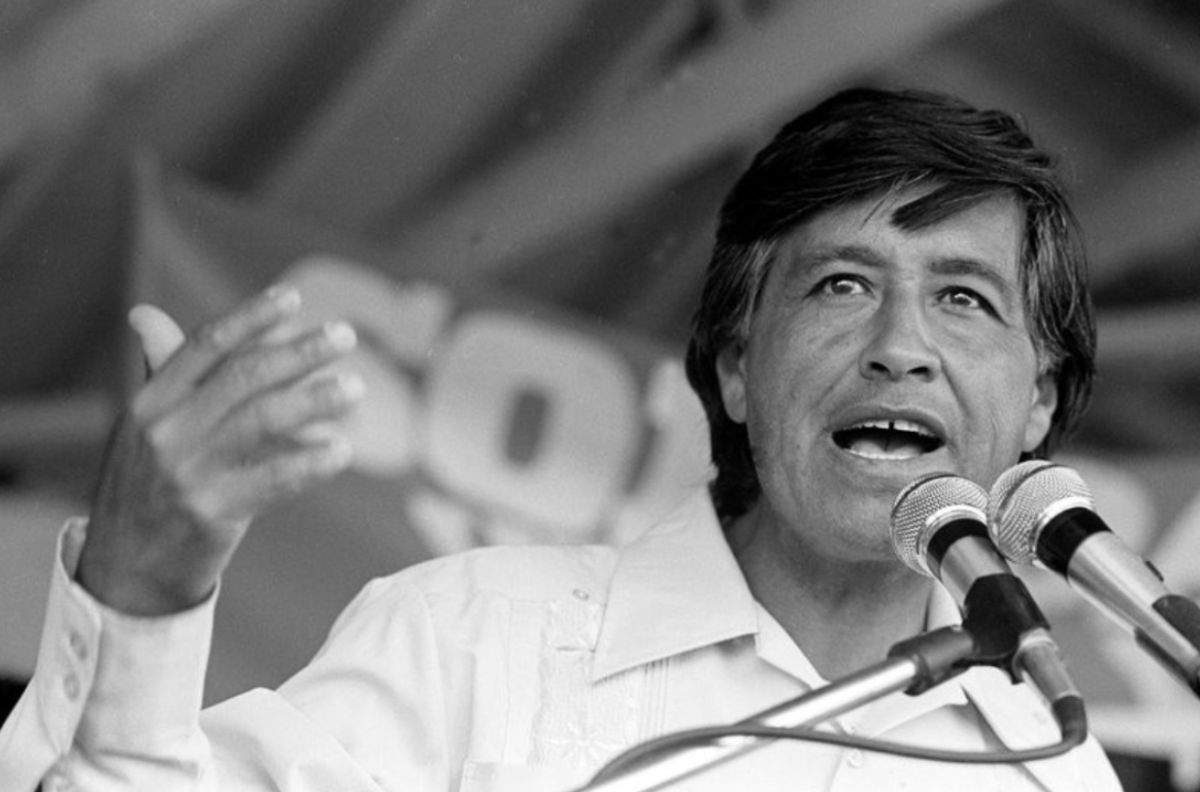
Cesar Chavez—a civil rights activist, co-founder of the United Farm Workers union, and hero to millions—has long been celebrated and honored for his fight for labor rights and justice. However, recent controversies have begun to challenge his legacy, as accusations from multiple women, most who were children at the time, claim that Cesar Chavez had sexually abused and assaulted them over a period of several decades.
These claims complicate the public image of Chavez making it necessary to visit the origins of the movement. On September 30, 1962, Cesar Chavez and Dolores Huerta established The National Farm Workers Association (NFWA) in Fresno, California which fought for the rights of migrant agricultural workers in California. California’s agriculture industry relied on the farm production supported by political allies that hired low wage workers from Asian, Native, and Mexican populations. Farmworkers toiled in dreadful, dangerous conditions; they were exposed to deadly chemicals and earned meager wages. Anyone who protested was quickly replaced by Mexican workers that immigrated through the Bracero Program, where the conditions were the same— inhumane. The Bracero Program was initiated in 1942 to fill in labor gaps left by Americans who were fighting in World War II; it ended on December 31, 1964 due to immense pressure from labor unions, civil rights organizations, and religious groups protesting the exploitation of Mexican workers.
In 1965 led by Larry Itliong due to low wages and substandard working conditions, Filipino American members of a different union (AWOC) went on strike in grape vineyards around Delano, CA. Cesar Chavez and the NFWA joined the strike, demanding a raise in their hourly wages and the pay for each box of grapes packed. 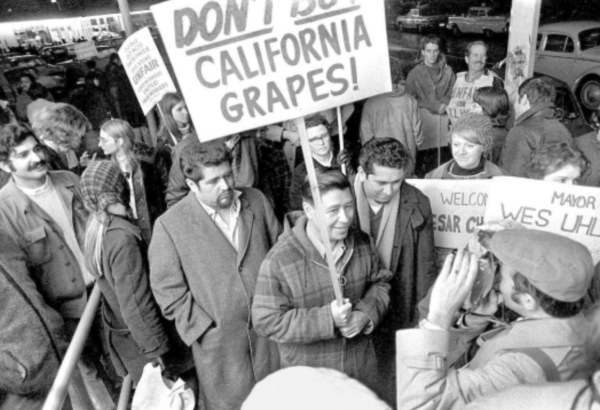 They directly boycotted grapes and performed secondary boycotts, where they targeted associated companies like banks or stores selling those goods. They started with Schengen Industries; thousands gathered in cities across the country to incite support, picketing grocery stores, bars, liquor stores. They also collaborated with other unions to boycott Schenley products, and by 1966, Schenley suffered a significant drop in sales and the boycott immensely hurt the company’s image. This marked the first time the Union successfully persuaded a company to sign a labor agreement with the NFWA. Having worked together during the grape strikes, the NFWA merged with the Agricultural Workers Organizing Committee (AWOC), becoming the UFW in 1966, strengthening the union. Through continued strikes and protests, the Agricultural Labor Relations Act was passed in 1975, greatly improving safety regulations for workers by granting the legal right for farmworkers to form unions and allowing them to choose their representatives, leading to investigations of unfair labor practices unions.
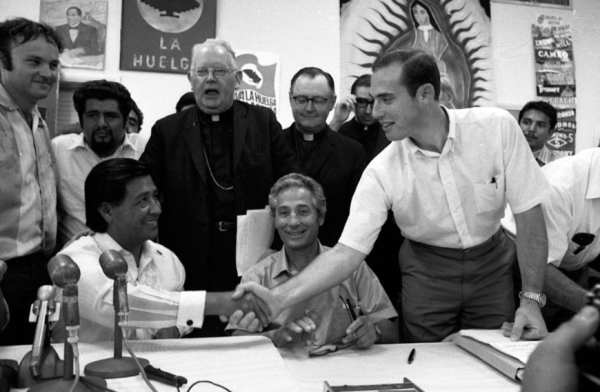
As a result, Cesar Chavez was recognized in various different ways. In 1994, he was posthumously honored with the Presidential Medal of Freedom, the highest civilian honor in the United States by President Bill Clinton. Additionally, his birthday, March 31st, is a state holiday in multiple states.
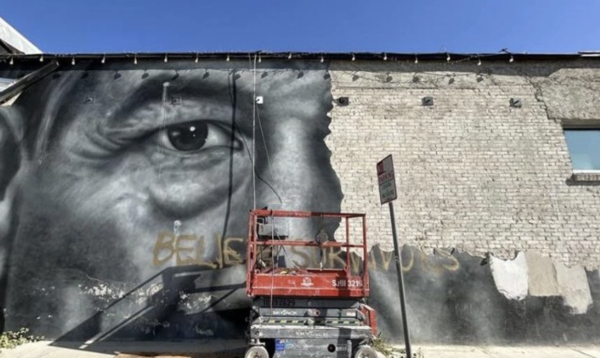
However, with the release of this new evidence, murals have been covered, marches have been cancelled, and names honoring Cesar Chavez have been changed. These allegations are supported by accounts from three survivors, along with extensive evidence documented by New York Times. Ana Murguria, a 13 year old child who recalled being summoned by Chavez multiple times for sexual encounters, spoke out first. She came out in March of 2026 regarding the allegations–upon being interviewed, Murguria labeled herself as a survivor rather than a victim, finally being able to accept Chavez’s abuse and her strengths after decades. This interview prompted Debra Rojas, another child involved in the UFW’s activism and a victim of Chavez, to be interviewed. Rojas’ parents were working with Chavez, and she confirmed Murguria’s statements–further claiming that Chavez had raped her during the rallies of 1975 when she was only 12 years old. Dolores Huerta—the less recognized founder of the NFWA—to speak out. Huerta stated that she felt compelled to share her stories of being sexually abused and raped throughout the 1960s upon hearing the stories of other women.
Many students grew up learning about the labor movement, being told the story of a heroic leader–the accounts from women who were harmed as children can feel unsettling, especially for those who looked up to Chavez. This also applies to those who navigate consent, boundaries, and trust. When someone who is labeled as a remarkable, just man is accused of assaulting younger women, it begs the questions:
How do we know who is safe?
Why do survivors need such extensive evidence to be believed?
Why aren’t schools teaching us the full truth?
For many younger individuals, these questions make the issue more personal. They highlight how common it is for people in greater power to have greater protections while their victims are ignored and doubted. They show why learning about sexual assault isn’t an unsafe topic, but something that occurs in the world every day, to everybody, and something that can be from anyone–including a civil rights activist.