
Every year, roughly 225 Americans die from anaphylaxis, a severe allergic reaction that can rapidly escalate from hives and itching to collapsed airways in a matter of minutes. Yet for millions of people at risk, the very treatment that could save their life goes unused. Why? The answer is simple: because no one likes needles.
For decades, one device has been the standard emergency treatment for anaphylaxis: the epinephrine auto-injector, most commonly known as the EpiPen. Now, a newly approved nasal spray called ARS-2, also known as neffy, is challenging the 50 year dominance of the EpiPen by offering, for the first time, an epinephrine treatment that requires no needle.
What is anaphylaxis, and why does treatment matter so much?
Anaphylaxis occurs when the person’s immune system overreacts to a trigger—from peanuts and bee stings to antibiotics or other substances—and the body releases a surge of chemicals that causes blood pressure to drop, airways to swell, and organs to stop functioning. Without intervention, it can become fatal within minutes.
The only drug proven to reverse this reaction is epinephrine, a synthetic version of adrenaline. “If you have a life-threatening reaction, epinephrine is the single most important drug you can use,” explains Dr. Mario Rodenas, an allergist and immunologist at Yale Medicine. “It relaxes the muscles in the airway, allowing for better breathing, and increases heart rate and blood pressure so that blood continues to flow to all the major organs. It also stops the release of histamine, the main chemical the body releases in response to allergens.”
So, if the problem is not the treatment itself, why are people not carrying it?
Why people don’t carry their EpiPens
As mentioned, the general treatment for anaphylaxis has been the epinephrine auto-injector, particularly the EpiPen, the well-known spring-loaded device that drives a needle into the outer thigh in an emergency. The EpiPen works well and is designed to be easy, portable, and safe. One click, and the needle instantly delivers epinephrine. However, fewer than half of patients who need them actually carry one regularly because of a fear of needles.
Fear of needles is more prevalent than many assume: in fact, studies suggest that up to half of adolescents and roughly 20 to 30 percent of young adults are afraid of injections. For these patients, the EpiPen sits unused at home or is left unfilled.
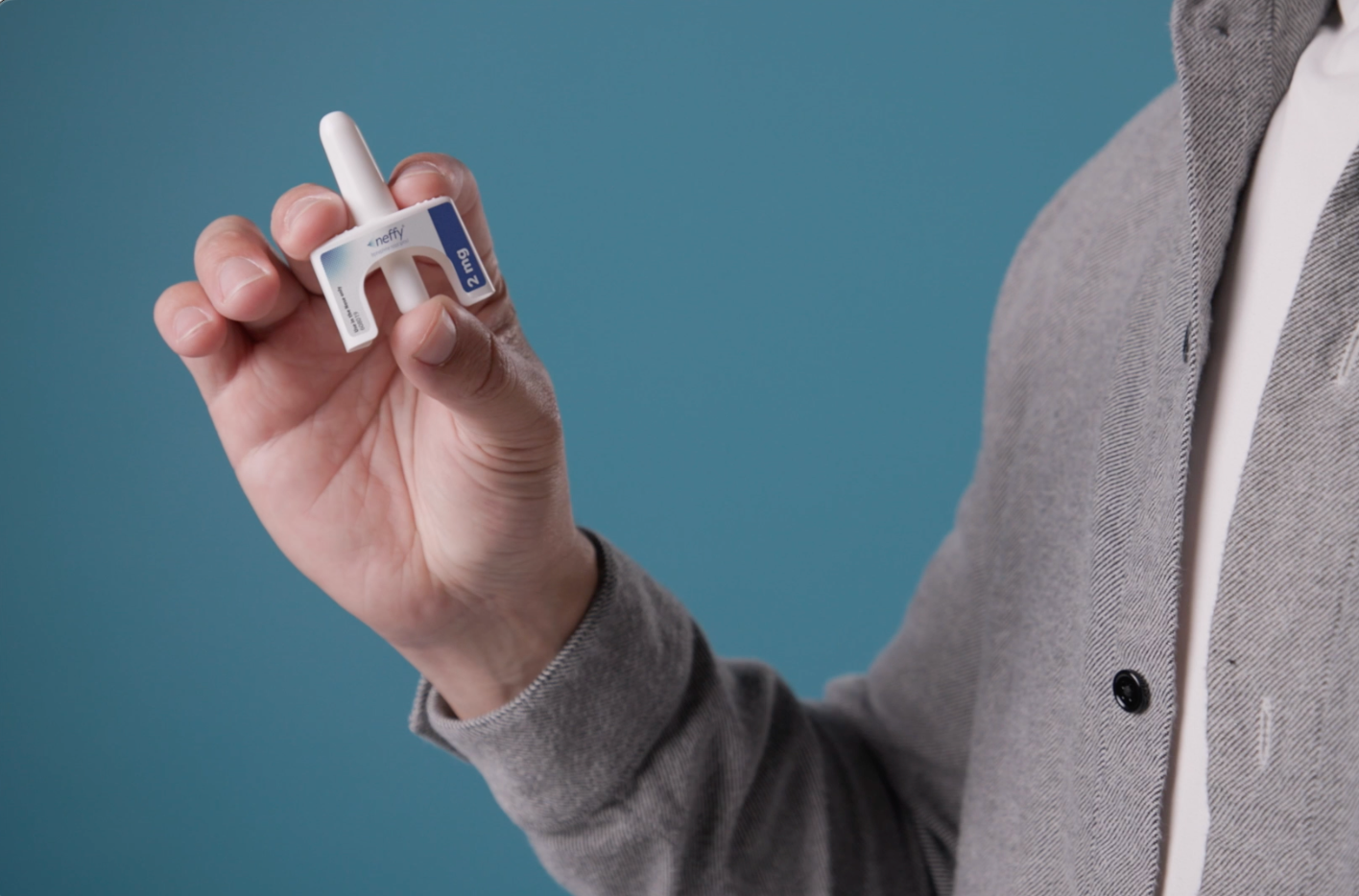
So, researchers sought to make a more convenient option, because the difference between having epinephrine or not can be as severe as life or death. Enter neffy: a nasal spray and the first non-injectable epinephrine treatment.
Neffy, the new nasal spray for anaphylaxis
Neffy, developed by ARS Pharmaceuticals, is an epinephrine nasal spray that delivers epinephrine without any needles, through a spray in the nostrils. In August 2024, the U.S. Food and Drug Administration approved it for adults and children weighing at least 66 pounds, making it officially the first non-injectable epinephrine treatment in history. The FDA also granted it “Fast Track” designation, a status reserved for therapies that address serious unmet medical needs.
Besides having no needle, neffy carries several practical advantages. At about two inches tall, neffy is roughly a third the size of a standard EpiPen, making it easier to slip into a pocket or small bag. It also has a longer shelf life, reducing the burden of regular checking and replacement.
Dr. Jonathan Spergel, chief of the Allergy Program at Children’s Hospital of Philadelphia, also says, “Epinephrine saves lives, but it’s a major problem that people don’t use it, so this could be a big difference-maker.”
But even if neffy is more convenient, none of its perks matter unless it can save lives with the same efficacy as injectable epinephrine. Thankfully, studies have pointed to the conclusion that neffy is the solution to this issue. While purposefully triggering anaphylaxis could potentially lead to harm to patients and thus is not a viable research strategy, a study that observed other factors—like heart rates and the concentration of epinephrine in the bloodstream—indicated that neffy is a viable alternative, even when patients have stuffy noses. Additionally, a study looking at patients who were tested for food allergies and developed anaphylaxis symptoms indicated that neffy was successful in real-world cases as well.
What are neffy’s limitations?
Nonetheless, though these studies demonstrate neffy’s success, there are still some concerns about its effectiveness. For example, if an allergy attack causes swelling, using neffy might inadvertently cause the nasal cavity to swell up as well. Furthermore, certain medical conditions can make nasal sprays less effective, like nasal polyps, soft growths on the nasal lining caused by inflammation. Another potential issue is that the limited clinical trials did not test participants during actual anaphylactic episodes. Some medical experts are concerned with lack of real-world data on neffy’s efficacy and are likely to advise patients to carry both neffy and an injectable device.
Ultimately, though neffy shows promise in saving lives, just like with any other allergy treatment, checking with an allergist before using it is key!
What is the future of neffy?
Neffy does not replace the EpiPen for every patient, and anaphylaxis will continue to remain a medical emergency. Yet, for many who avoided carrying epinephrine because of needle anxiety, the approval of this nasal spray makes tragedy from anaphylaxis more preventable.
“At the end of the day, there is the question of compliance,” says Dr. Rodenas. “It may be better to have a patient who will use a device they have chosen and are willing to use, as opposed to not using one and potentially dying from anaphylaxis.”