

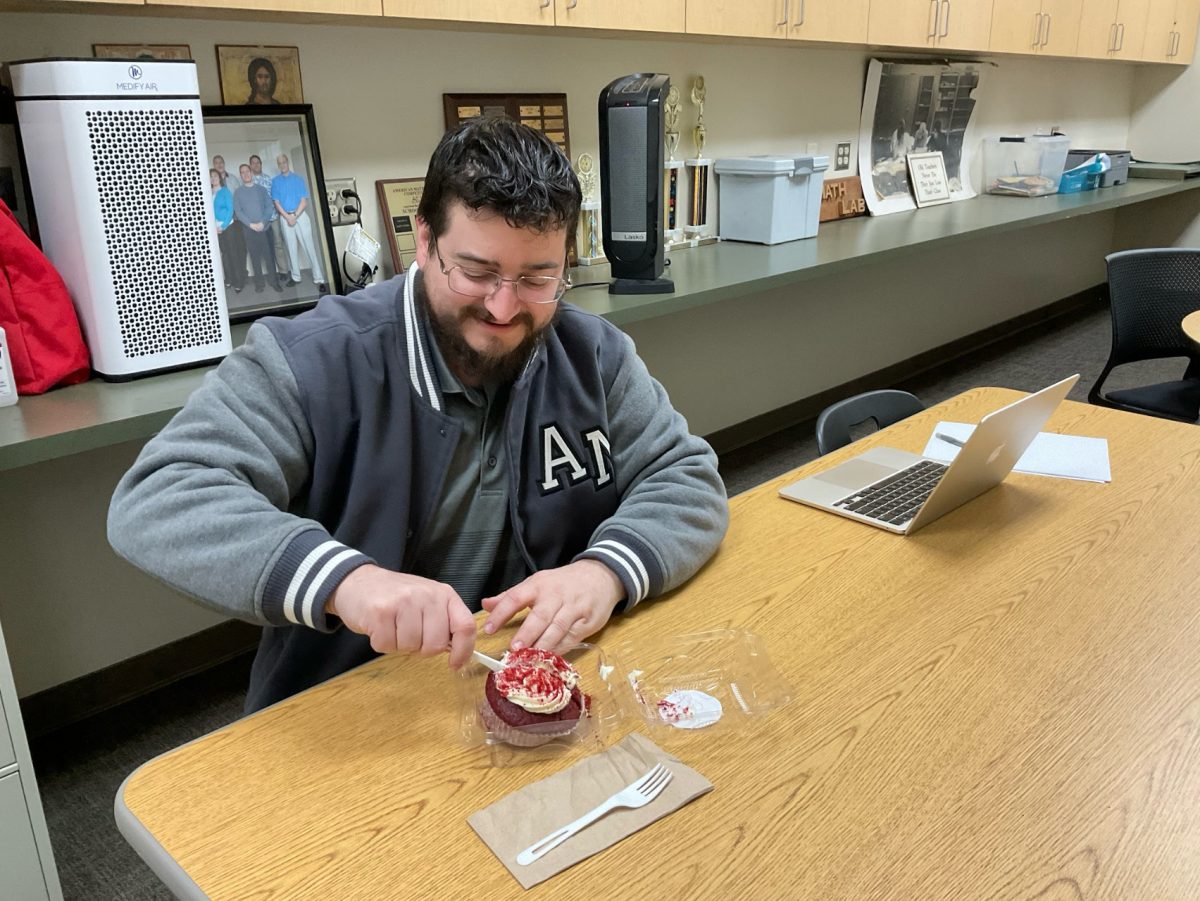
It starts with a cupcake, a decadent tower of red velvet and cream cheese. But its sweetness is deceptive—as anyone with a sibling knows, a single treat can cause the biggest disagreements. This is where the math begins: how do you fairly split a cupcake?
From something as mundane as cake to maneuvering the invisible strings that control the world, math is quite literally everywhere, determining who gets resources, opportunities, and power.
To learn more about the new Mathematical Justice class that will explore these ideas, we interviewed its new architect and teacher: Mr. Linhares. Through his decade-long teaching career, he has consistently integrated justice-related topics in his curriculum. During COVID-19, he taught voting theory as part of another class. When he was a long-term substitute for an economics class this year, he gave students a preview of some of the concepts that will be central to this course. He’s wanted to teach a course focusing on mathematical justice for years, and next fall, his dream will finally come true.
Although Mr. Linhares’ notes that he enjoys talking about all the topics covered in this course, he has a particular fondness for game theory—a mathematical system that is the backbone of strategic decision-making. These models, he explains, are common knowledge amongst the world’s richest individuals but remain a mystery to most people, who don’t even know of their existence.
But each one of these systems has their value, and it’s within them that the rich and influential harness their power. From power indices which point to who truly has power in our society to voting theory that illustrates how to make a vote count in an election, each one of these topics has a real application far beyond the class. To Mr. Linhares, his ultimate hope is that students are able to use their understanding of the topics taught to decipher problems in the real world and create lasting change: Mathematical Justice.

Mathematical Justice is an unorthodox class by nature, so students can expect its classes to unfold differently from any they have taken before. Rather than tackling math from a traditional perspective, students will interact with problems that don’t even involve numbers. As Mr. Linhares states, math is fundamentally about “the study of structures and how things relate to one another.” For instance, algebra can be seen as the structure of conservation, where a careful balance must be maintained and values cannot be simply created or destroyed.
But not all systems in the real world follow this principle. Mathematical Justice explores this idea by analyzing political and economic systems through a mathematical lens. One example is fair division algorithms, which focus on how assets can be distributed in a way that participants perceive as fair. A classic scenario is the “one cuts, one chooses” method, often illustrated with cake-cutting. To ensure a sense of fairness for both parties, one person cuts the cake while the other selects their preferred portion.
Additionally, Mr. Linhares expresses how the structural architecture of math dictates the distribution of power: the ability to change things. Another topic that will be taught in this course is power indices, or ways of ranking where true power lies. Mr. Linhares illustrates this concept with a scenario where a company’s shares are divided between three stakeholders. One person possesses 49% of the shares, one has 48%, and the other has 3%. If a majority vote is required to ignite change in the company, we may immediately assume that having 49% is tantamount to having the most power. Yet in reality, 49% can’t usher change alone, it needs either the 3% or 48% to vote with them. This applies to all three of the shareholders, as no single entity can reach the 51% threshold independently and two must coalesce to enact change. Thus, their power is essentially even in this system; their ability to initiate change is equitable.
Of course, this is a simplified model and the real math is much more complex, but these basic ideas ultimately accumulate into intricate processes that govern our lives. These initially paradoxical concepts challenge students to move beyond immediate observations and analyze the underlying patterns.
Mr. Linhares also emphasizes having students actively participate in this class, so they can experience these systems first-hand, then use math to digest the content more effectively. Through simulating the yardsale model, actually voting to understand voting theory, trading tokens for economics, and more, students can directly witness just how predictable these systems are.
To put it simply, Mathematical Justice does not require advanced math. The only prerequisite is Algebra II, meaning students do not need prior knowledge of geometry or calculus. For those interested in how math applies to real-world topics—such as finance, interest, and bail systems—without the pressure of solving complex integrals, this course offers an accessible and engaging alternative. In fact, most of the arithmetic involved is limited to basic operations like multiplication and division.
Because of its reliance on only foundational mathematics, Mathematical Justice is a course that is welcoming and accessible to all. Inherently, math is widely considered the “foundation of everything” and is surprisingly linked to subjects including history, philosophy, and even music. Even students who don’t traditionally enjoy math will find themselves fascinated by the content of this course due to math’s ability to answer questions regarding historical events and social challenges.
Students should definitely consider taking this class in order to learn about pertinent social justice issues and uncover the roots of inequality and power dynamics in our society. Equipped with this knowledge, Mitty students can translate their education into action, making impactful changes in the future. Moreover, this class allows people to deepen their understanding of topics such as finance, economics, politics, and how corporate governances work.
Mathematical Justice covers a vast array of subject matter that is applicable to everyone, not only STEM-inclined individuals; the course encourages a deeper comprehension of power imbalances and teaches students skills to navigate them in their daily lives, especially in leadership positions. By participating in Mathematical Justice, students will gain the necessary insight on societal issues that will drive them to make a difference later down the road.