


At first glance, the lunch line seems straightforward: wait in line, buy food, eat.
This is a misconception. The lunch line is, in fact, a dynamic system governed by economics, fluid dynamics, and game theory.
We can define such a system with the following equation: 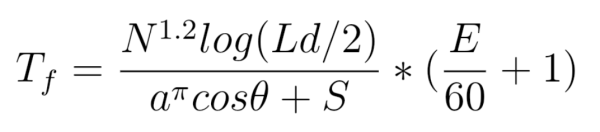
The objective is simple: minimize Tf, your personal time to reach the front of the line. Let’s examine the above model, which is derived from reasonable assumptions and selectively interpreted data.
Queue length N
The most obvious factor—and arguably the most important—is your position: how many people are standing in front of you.
We can also estimate N based on another equation: 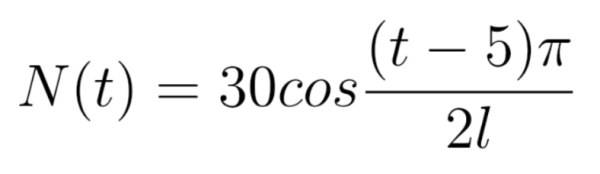
Where t is the time (in minutes) after the start of lunch and L is the duration of the lunch period (in minutes). Unfortunately, the implication is clear: the earliest you can get your lunch is to arrive early and tough it out.
Alternate queues L
The number of available serving windows. While more windows should in theory reduce wait time, line switching often backfires, resulting in a self-inflicted delay rather than a strategic maneuver, consistent with Braess’ paradox.
Crowd density d
A measure of queueing students per square meter, d determines how freely you can move in the line. At high densities, the line acts like a viscous fluid, with edges moving at near-zero speed. Choose your line wisely.
Audacity-aggressiveness factor a
A latent variable (ranging roughly from 0 to 2) that captures a student’s willingness and ability to assert dominance in the lunch line, relative to the entire queue. Possible factors include social awareness, physique, and friends who would help you cut. This number can also be used to roughly estimate your chances of survival if the line were to become a free-for-all food fight.
Line speed S
The number of students obtaining lunch every minute, at each window. Typically, this ranges between 1 and 3, due to variations in orders and efficiency. Remember, while some lines appear faster, this is often an illusion.
Environmental entropy E
An observational variable estimated by disturbances from the ideal—such as noise, dropping objects, and anything possibly annoying (per minute). These can degrade focus; consistent with prospect theory, a high E value results in a greater sense of frustration. Most overly rational beings assume E = 0, but this assumption rarely survives reality.
Angle of Attack ϴ
The angle at which you position yourself relative to the path. The optimal strategy is a vertical, forward-facing orientation aligned with the direction of flow. Any deviation decreases your autonomy in the line.
The Bottom Line (what you’re here to read)
By applying careful observation and precise calibration, we can reduce Tf through many small adjustments: choose your time wisely, stay focused, and stand your ground.
According to extensive calculations, modeling, and analysis, one strategy dominates all others: Maximize the only truly controllable variable (a, your audacity-aggressiveness value), break all social constructs, and advance unilaterally for your own gain. After all, it’s a free country, right?
In theory, this is the perfect solution: your time can be near zero. But in reality, there is a catch—you won’t be the only one cutting. It is the modern-day Tragedy of the Commons, or more precisely, of the lunch line, where rational behavior inevitably leads to collective failure.
Or you could, you know, bring your own lunch?