
From Barbie to Britney Spears to Breakfast Club, American history is filled with so much more than many students realize from their core curriculum at Mitty. Modern American History, a one-semester senior social studies elective, takes students from the 1950s to the present day as they examine presidents, pop culture, movements, and more. Mr. Will Scharrenberg, who teaches the class, organizes the curriculum by decades. Throughout each time period, he emphasizes immersing students in the content by connecting it to familiar modern-day concepts, whether it be through whole-class debates or watching McDonald’s commercials through the decades. The class’s unique approach to American History encourages one to both learn historical events and analyze current ones, giving students the tools to examine and navigate the real world.
Senior Melina Fass elaborates on how the class has taught her not only history content, but also how to “listen differently and listen with intention.” In class, students consider concepts such as media bias and political strategies to analyze media, websites, and articles through the decades; Melina has found that this has helped her consume real world media with a purpose–”not only seeing things for what they are, but also gaining a little more context into what exactly things stand for.” By analyzing literature from both the past decades and the modern-day through a real-world media context and the skills taught in class, students can “see that there’s value in what’s included, but also a meaning behind what’s left out and the way that things are phrased,” allowing them to build their own perspectives in a more informed way backed by critical thinking.
Senior Tommy Hu picked the course largely because he had enjoyed Mr. Scharrenberg’s college prep U.S. History class as a sophomore. After taking Modern American History, Tommy now sees the country around him as the result of decisions made decades ago. The topic that has stuck with him most is President Dwight D. Eisenhower’s presidency and the interstate highway system. “Every time I go on the highway, it’s interesting how everything’s connected,” he says, pointing to the fact that the first fast food chains along every exit and the numbering system routing highways north to south or east to west are both byproducts of Eisenhower’s original policies. The course asks students to make similar connections on their own in the pop culture project, where each student picks a film, television show, or cultural artifact from a given decade, explains why it mattered at the time, and ties it to something in the present. Working through sitcoms like Modern Family and Seinfeld along with franchises like Star Wars, Tommy remarked on how much of today’s entertainment is still running on ideas from the 1970s and 1980s.
Across the course, Mr. Scharrenberg grades his students on their ability to defend a position with evidence. The first major exercise comes in the second week of the semester, when he hands out forty-five political cartoons published the week of September 11th—some patriotic and some sarcastic—and asks each student to defend an interpretation of one of them. When the class covers the Iraq War, Mr. Scharrenberg scales the activity into a class-wide debate, splitting his room into four approaches: invade, work together, pull out immediately, or stay out altogether. Mr. Scharrenberg leaves the choice of camp entirely to the student. “I really don’t care what you pick,” he says. “You just have to give me an example.” He cautions that a student who skips the readings “can’t make an argument,” emphasizing the importance of wielding solid evidence.
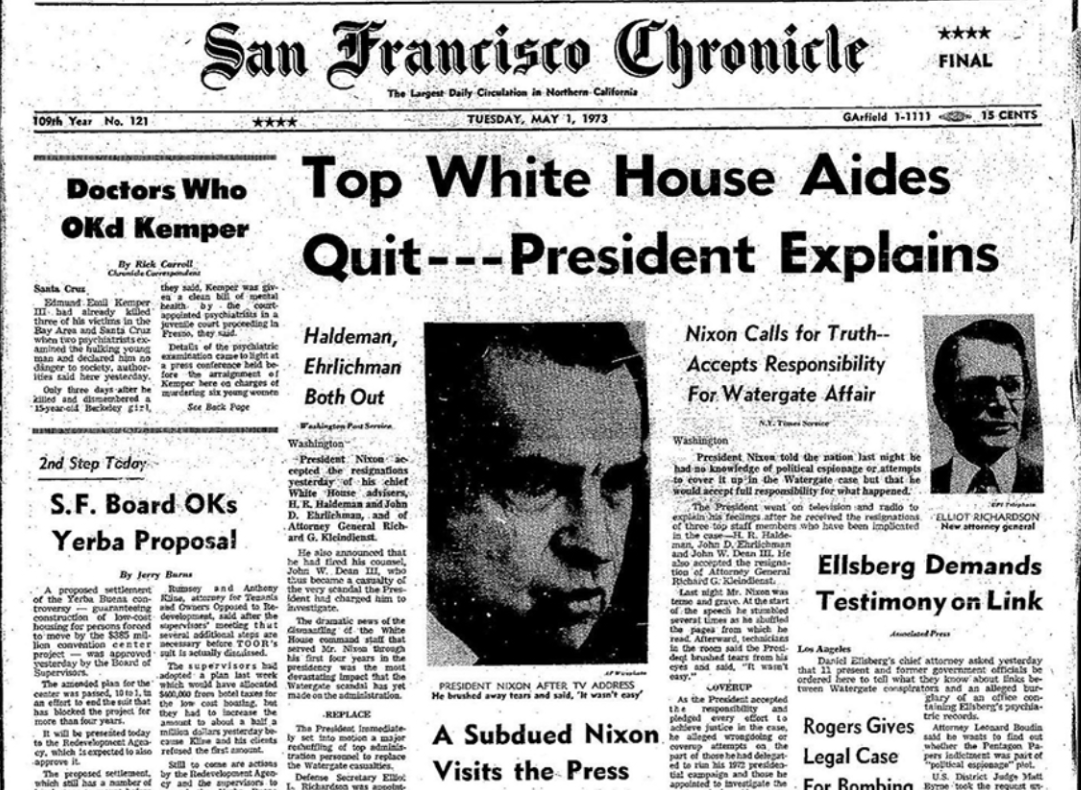
Some of the material is recent enough that it enters the classroom via the students’ personal lives. One year, a student’s parents had lived next door to a Flight 93 passenger from Los Gatos, while another year, a student’s father had gone to school with Christa McAuliffe, the teacher who died on the Challenger Space Shuttle. For these students, the events they learned about in class supplemented the personal knowledge and perspectives they gained through their families’ histories. Acting intentionally, Mr. Scharrenberg is able to bridge the recency of these stories with the impact history had on his students, proving that what they learn is not as distant as it seems. For instance, he traces the stretch from JFK’s assassination through the Great Society, Vietnam, and Watergate to illustrate how “the way we looked at the presidency completely changed, to today.” In fact, he spends close to a week and a half solely on Watergate, a scandal Tommy says turned out to be more complicated than he had realized.
Ending in the present day, the course returns to the motif of evaluating media. Namely, the final exam makes students pitch a family sitcom set in the year they take the class, extending an opportunity to capture what the America they are living in actually looks like—history in the making. From highways to hearings to Hollywood, Modern American History leaves Mitty seniors with the tools to scrutinize their own decade with the same sharp eye they have brought to the six before it.