

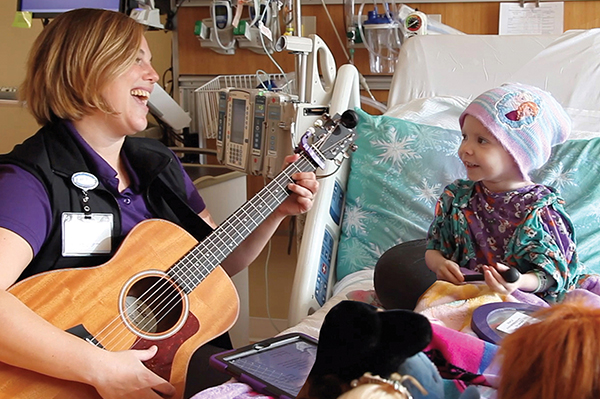
We’ve all heard of waiting room music, whether it’s the random Mozart piano music in the hospital or the annoying country guitar while you’re on hold waiting to make an appointment with your dentist. But what if those familiar tunes could do more than just fill the silence; what if they could actually heal? In fact, music is emerging as a powerful tool in aiding both physical and mental recovery, playing a key role in everyday life and overall health and wellness.
Music has always been an integral part of human civilization. The practice of music as a form of healing can be traced all the way back to Ancient Greece in the writings of Aristotle and Plato and in some cultures, long before that. Picture this: you’re in Ancient Greece and you’ve just been bitten by a viper and, instead of medical help, someone starts serenading you with a flute and harp.
The Ancient Greeks might have taken the whole “music heals” idea a little too far, but still, music is more than just background noise—unless you’re the snake, in which case it’s probably dinner music. Either way, music is more than just a comforting presence. Behind the catchy tunes and cute lullabies, the human brain does a lot more than just hear.

How Music Shapes the Brain & Body
Like any other sound, music arrives at the ear in the form of sound waves. These sound waves enter the ear and cause the eardrum and tiny bones to vibrate, which moves fluid in the cochlea and triggers hair cells to send electrical signals to the brain through the vestibulocochlear nerve for interpretation. I know, the reading voice in my head couldn’t say that either. But according to Harvard Health Publishing, scans of different sound waves’ effects on that nerve show that the different parts of the brain all decode and interpret various properties of different music.
For example, a small area in the right temporal lobe is responsible for understanding pitch, which forms the basis of melody, chords, and harmony in songs. So when listening to your favorite One Direction song, your right temporal lobe is what’s being blessed to decode the heavenly harmonies of Harry and Zayn. Another part of the brain, called the cerebellum, processes rhythm, and the frontal lobes interpret the emotional content of music. With these sound waves triggering all of these different parts of the brain, music physically helps organize the firing of nerve cells in the right half of the cerebral cortex, the part of the brain responsible for higher functions.
So next time you feel guilty about not going to the gym, know that simply sitting on your couch and listening to music counts as exercising too–except it probably just won’t give you the six-pack abs just sinking into the couch.
But music can also help you with physical movement, too, especially when it comes to the elderly (that’s your cue to go show grandma and grandpa this). Steady walking and falling are serious problems for older people today. In fact, one out of every three senior citizens suffers at least one fall during the course of a year. So if grandma and grandpa are walking fine, that’s probably a sign that your rickety, old neighbor shouldn’t be climbing up those stairs for a bit.
Maybe listening to music could help her? In a study conducted by The River Calm, a group of 65 and older men and women, who were at risk of falling but free of major neurologic and orthopedic problems, were tested to see if music helped them. Half the volunteers were randomly assigned to a program that trained them to walk and perform various movements in time to music, while the other people continued their usual activities.
At the end of six months, the “dancers” exhibited better gait and balance than their peers and also experienced 54% fewer falls. Another similar study found that movement to music appears to improve the mobility of patients with Parkinson’s disease. So your jamming to “Please, Please, Please” by Sabrina Carpenter is turning into grandma and grandpa jamming to “Please, Please, Please Don’t Fall Down the Stairs.”
Emotional, Cognitive, & Everyday Benefits of Music
Music also plays an important role in reducing anxiety, stress, and depression as well as in improving mood, concentration and learning abilities. For example, music can stimulate the release of neurotransmitter chemicals like dopamine, serotonin, or endorphins that have mood-boosting and calming effects. Endorphins are also known as natural pain relievers and mood elevators, which, when released, can create a sense of happiness and contentment.
It’s like, whenever you’re sitting down to do your APUSH homework that’s due in less than 8 hours, and the only thing that can make the next 3 hours of work somewhat doable is your favorite cheer up song. For me, it’s “Baby”—I mean, who can doubt that baby Justin Bieber’s voice just hits different?
And, there’s no way you’ll find me moping over my APUSH textbook when that song comes on my playlist. Similarly, music, by stimulating the release of endorphins, can significantly reduce depression and anxiety. In fact, a meta-analysis of 55 studies, conducted by philosophy doctor Sonja Aalber, found that music reduced depression symptoms by 25-35% and anxiety by 30-40%. Huh, no wonder “Baby” became popular!

But I know, as a high school student, anxiety and depression aren’t the only things we have to deal with. There is also the stress. Let’s face it, there’s no one in this entire world who feels more stress than a high schooler right before their AP Calculus final exam. But, like how music can reduce levels of depression and anxiety, it has also been seen to reduce stress.
A 2021 Harvard study from New York examined how music affects surgical patients right before their operation. They found that the blood pressure of patients who listened to music of their choice stayed down immediately after the operation, while, with patients who didn’t listen to music…Let’s just say their blood pressure spiked higher than my heartbeat during a Stray Kids concert.
And finally, because I know all of you want to find a way to regain those brain cells you’ve lost while doomscrolling TikTok, music can also enhance your concentration and learning abilities by improving mood and motivation. For example, music triggers the brain’s reward system, dopamine, which can make learning more enjoyable and easier to understand. It’s like with my APUSH MCQs–I have to credit my solid A- to Justin Bieber, because, without his music, I would never have gotten past the first page.
And it’s not just that it makes learning more enjoyable, music also boosts your motivation and can give you a better reason to actually not just blankly stare at your MCQ test paper and question your life decisions. For example, music can quickly put you in a good mood and can make you feel positive, energized, and empowered, making you more inclined to tackle tasks effectively. Additionally, music can also distract you from any fatigue, negative thoughts, and stress, allowing you to focus on the task at hand and shift your mindset towards a more motivated and positive one.
So, next time someone tells you to turn down your music, just remind them you’re self-medicating—with science on your side! Whether your playlist includes the classics of One Direction, trending Sabrina Carpenter, or that vintage Justin Bieber, you’re doing more than just jamming, you’re strengthening your body and mind, improving grandma’s balance, and conquering AP Calculus stress, one beat drop at a time. If only Spotify subscriptions were eligible for health insurance coverage; now that would be really music!