

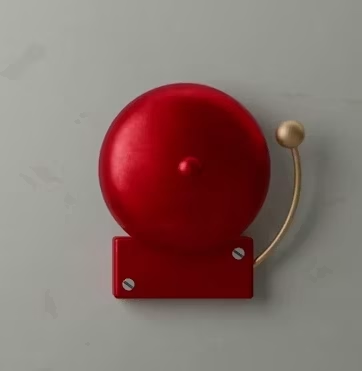
“123 – release ‘em”
It’s 9:47, two whole minutes after first period was supposed to end, and I’m still stuck in class, daydreaming about food. Half of my class is already packed up and pointedly staring at the clock on the wall. I glance anxiously at my neighbor: am I going to be late for my next period? I have a super important test and I have sixty-seven questions to ask my teacher before it starts. If only teachers had some magical leprechaun sent from heaven, who could hysterically scream in their ear when class is over…but wait! What about a bell?
The school bell is an auditory signal that regulates the school day, alerting teachers, students, and other staff of the start and end time of each class. I’m sure you remember the loud, jolting, terribly jarring bells from elementary school. But not all bells are created equal, and there are many other alternatives to the traditional physical bells—such as a melodious tone or a calm, soothing chime.
Sure, bells could stimulate us all to be Pavlovian dogs, feeling an inexplicable sense of relief whenever we hear the familiar tone of the bell. Sure, bells originated from training students to become factory workers, methodically complying with the same sound. Sure, bells can abruptly cut a class short before the teacher has had time to explain the homework, leading to confusion. Silly arguments aside, it is completely reasonable for Mitty to have a bell system.
To begin with, a bell system would enhance efficiency in our school. Schedules can be streamlined, and times are communicated effectively. I know right when class starts, and right when class ends, allowing for a tight schedule between classes. It could also help to unclog the completely congested hallways a little, since students are able to know when to go to class instead of mingling for an unforeseen amount of time and following the crowd to class.
Moreover, a bell system could clarify class structure on days with irregular class periods. I’ve definitely walked to my first period class instead of my homeroom before, confidently opening the door to imagine a bunch of seniors rolling their eyes, as if to judge my lack of awareness. It would be great if I didn’t have to lose any more aura. Tripping down the stairs of the terrace is already enough aura loss.
A bell system could also foster a sense of punctuality and allow students to be on-time for classes during the day. It’s difficult to know when lunch periods start or end, and now I don’t have to be late for my 3B class or lose my phone to the dean for checking the time—or even worse, lose aura by pulling out my iPad in the middle of the hallway, looking like a classic nerd straight out of High School Musical. No more “walk of shames” to the office to get a late slip or written detentions that will magnify the early onset carpal tunnel in my hand. Now I can be on time for my classes and avoid the dirty look of shame my teacher gives me when I’m 20 seconds late.
A bell system would help preserve focus in the most terrifying of classes, avert students’ catastrophic chronic health conditions (carpal tunnel), and emphasize punctuality when students are considering walking across campus to get a cookie.