

Can you ever really be sad in a Ferrari?
Yes. The answer is always yes.
Ferrari is an F1 team that keeps getting faster…in all the wrong places. They are so quick it only took them three years to traumatize “rookie” Fernando Alonso, just two short years to ruin smooth operator Carlos Sainz, and a single season to give Charles “Banana” Leclerc PTSD (Pit-lane Traumatic Stress Disorder). These drivers were never the same again—and neither were their hairlines, which seemed to recede faster than their race pace.

Despite numerous complaints about car reliability from these drivers, Ferrari leadership appears to be incapable of fixing these issues. And that’s the paradox of modern F1: with even more telemetry and AI-generated analysis than any era before, teams can still fail spectacularly if they can’t interpret the data or act on it. Telemetry, the process of recording and transmitting the car’s data back to the engineers, is one of the most important pieces of technology behind Formula 1.
What exactly is Telemetry?
Telemetry is the capturing and transmission of real time data from a distant source, in order to help engineers analyze what’s happening without ever having to touch the car themselves. Which is good, because sometimes it seems like Ferrari’s engineers are too busy touching their heads in disbelief. Much of this data comes from the more than 300 sensors attached to different areas of the car: the engine, gearbox, suspension system, wheels, front wing, floor, and even in the driver’s gloves. These numbers are sent wirelessly through radio waves which carry all the readings from the sensors to the engineers at the pit wall. In addition to radio transmission, teams often use satellite systems and antennas to ensure that this data is properly transmitted even when cars are moving at speeds over 200 miles per hour.
However, if engineers were expected to decipher this data all by themselves, they would ruefully admit, as Leclerc once did, “I am stchupid, I am stchupid, I am stchupid.” Fear not, this data is processed through high speed computing systems like server racks, machine learning pipelines, and predictive models to help turn the raw sensor data into more helpful information: strategy options, car reliability warnings, performance predictions, tire wear, and setup adjustments.
Even the FiA (known dearly to F1 fans as Forever an Incompetent Association) also uses the telemetry data in order to analyze crashes, enforce race rules, and develop new safety protocols, though their stewarding has often been as reliable as a Ferrari pit stop strategy.
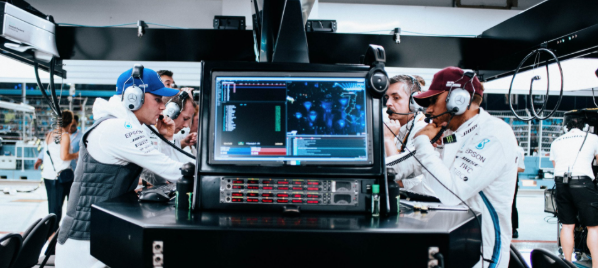
All F1 cars, packed with over 300 sensors, send teams over a million pieces of data every second. Some of this data measures the performance of the car: speed, fuel consumption, how far the driver is pressing the throttle, or how hard brakes are being applied. Other sensors focus on the tires, measuring temperature, pressure, and how quickly they wear, since even a 1 degree Celsius change can affect the grip on the track. Aerodynamic sensors placed on the outside of the car measure important forces acting on the car, such as air flow, drag, and downforce, thus helping teams understand how the car performs on corners versus straights—something Lance Stroll hasn’t quite figured out yet.
The hybrid system in the car also has sensors tracking the battery charge as well as energy recovery, enabling engineers to predict the maximum amount of electric power that can be used. Finally, the environmental sensors on the car track the temperature, humidity, and the car’s exact GPS location to watch where it is located on the circuit. By collecting all this data and processing it through high speed computing systems, engineers are able to have a clear picture of the car’s condition as it changes every millisecond.
During practice sessions, telemetry allows teams to optimize car setup and simulate race conditions. This is when engineers tweak parameters like suspension settings or aerodynamics to get a better understanding of how the car behaves on the circuit. In qualifying, the data helps fine-tune the car for maximum one-lap performance, pushing it to its limits.
Throughout the race, telemetry is key to monitoring car health, predicting failures before they actually happen, and adjusting race strategy—such as determining when to pit and which tires to use. Engineers can also simulate future laps in real time, allowing them to test strategies mid-race—something Ferrari fans wish their team had done before, say, the 2022 Monaco Grand Prix.
Impact of Artificial Intelligence
The combination of AI and human analysis has become one of the most powerful aspects of modern F1. Telemetry feeds into AI simulations and machine learning models that predict race outcomes, enabling teams to make smarter decisions. The race engineer then interprets this data and conveys it to the driver, helping guide them through the race.
Teams with sophisticated AI systems and telemetry tools will soon be able to make decisions faster than humans can react. The implications of this tech are immense, and as AI advances, it will likely play an even bigger role in shaping race outcomes. But as with all changes in F1, the big question remains: will F1 embrace AI, or will it draw the line at letting machines make split-second decisions?
Looking to the Future
F1 has become as much a sport of data as it is of driving, and the balance between human skill and machine precision will ultimately determine the future of the sport. And while Ferrari may not always have the fastest car on the grid, they’ve certainly become experts at keeping fans on the edge of their seats with every race… whether they’re breaking records or, well, breaking everything else.