

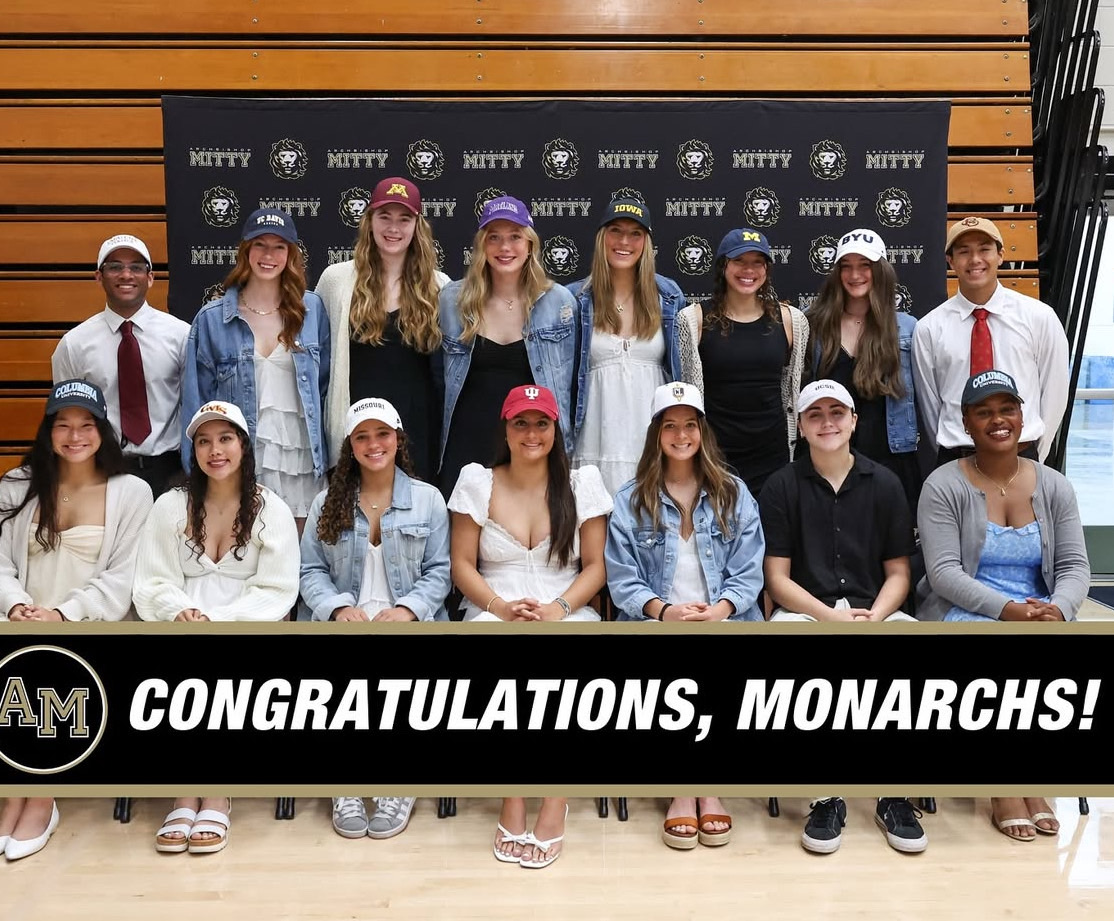
Of Mitty’s many prestigious traits, perhaps the school’s most well known quality is its star-studded athletics program. Each year, dozens of Monarch athletes receive D1 scholarships to play their sport at the next level, with examples including Aaron Gordon committing to the University of Arizona in 2013 and Danny Scudero committing to Sacramento State University in 2022. This year’s senior class has been no different, with Kyleigh Mace and Enzo Balbuena being two of many talented D1 athletes aiming to make their sport a career.
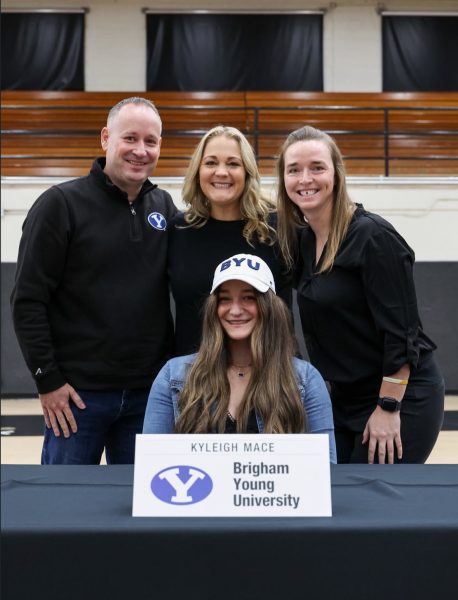
Senior Kyleigh Mace committed to BYU for softball around a year ago. Kyleigh decided that she wanted to play in college when she was only 13, when her coach told her that she had the potential to go D1. This vote of confidence was the boost she needed to go all in and truly consider her chances of college recruitment.
However, her path did not come without its challenges. At 14, the team she was a part of, consisting of her closest friends, was not strong enough to qualify for the tournaments with college recruiters watching. When the season ended that fall, she made the tough decision to leave and join a more competitive team. Despite this, it did not get much easier for Kyleigh, who realized that she was now going to have to work even harder than before to keep up.
Beyond just the general schoolwork she was given, Kyleigh felt as though she was working a second job, sending around 20-50 emails a week before tournaments and flying to camps across the country. Unlike many other D1 hopefuls, Kyleigh didn’t attend any recruitment camps until she was 15, at which point she had a lot of catching up to do and far less time to learn the ropes.
Although many may claim that softball is an “easy sport” compared to baseball, Kyleigh disagrees. She specified that a player’s “reaction time in softball must be much quicker than people assume.” Additionally, in softball, pitchers are much closer to the plate when they throw—and it typically takes less than three seconds to get to first base for the batter, whereas the MLB average is around four. The game is a lot faster as a result and requires a faster reaction time. This all took a lot of learning, including failing, to get used to.
Luckily, although failure can feel scary, especially in front of college coaches and strong, equally skilled athletes, Kyleigh learned to accept that it was simply a part of the game. The way a player responds to failure is often something recruiters watch for. Specifically, Kyleigh states that “Coaches want to see how you recover, and if they’re not willing to give you another chance after failing, it probably isn’t the best fit anyways.” As well, she advises younger athletes that it’s important to truly explore your options to the fullest when it comes to college decisions.
When the moment of choosing a college to commit to came around, Kyleigh opted for BYU. From the second she stepped foot on campus, she felt that BYU was where she needed to be, quoting the classic line “when you know, you’ll know.” At the same time, this commitment was a daunting and surprising choice for her to make. Growing up, Harvard had always been her dream university and BYU would not have even made her top 5 schools list. Now after her college visits, she realized that “Harvard was not for me at all and BYU seemed like the perfect fit.”
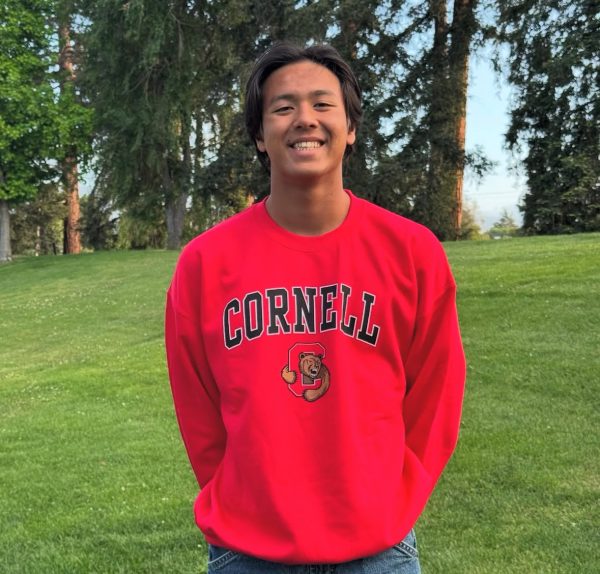
Similarly, for Senior Enzo Balbuena, the road to commitment was not without its challenges. Last year, the star swimmer made the decision to commit to Cornell’s swim team after securing multiple impressive titles at sectional and state championships.
Enzo was aware of his athletic intentions from a young age. He states: “[I realized] pretty early on, like in elementary school, that I wanted to swim in college. I remember seeing the older kids on my swim team go through the recruitment phase.” Those kids served as role models to Enzo, who hoped to one day “get to their level.”
Like Kyleigh, though, he faced many challenges too. For one, Enzo had to reach out to colleges to advocate for himself. Beyond that, he received large volumes of college emails that he had to individually sort through. Many of those emails were of schools he had to do additional research on and with his little knowledge of the East Coast (having never visited himself), he found it hard to decide on any place in particular. Plus, he had to regularly update a large portion of those emails regarding his life in order to stay in the loop. Luckily, with those emails, he received many follow-ups. He states that “several [schools emailed him about] how they enjoyed reading [his] very personal emails and how the quality of them helped [him] stand out.”
Despite the initial trouble Enzo had when deciding on a college commitment, he eventually found his home in Cornell. The community there treated him not as another recruit, but as a potential future teammate. Enzo could tell that with Cornell, he would grow both as a swimmer and as a student. His eventual choice led to a feeling of relief as well. Cornell, a prestigious school with a good reputation, wanted him. The comfort in knowing that was important.
Like Kyleigh, Enzo often faces misconceptions about his sport. Many assume that swimming is just a solo endeavor–but Enzo argues the contrary: “It has a big team aspect, especially in college. Practicing with them every day, you come to share experiences with teammates that you won’t have anywhere else. The pain of a hard set, the excitement of relays. You start to realize that you aren’t swimming just for yourself, but also as a representative of your team, and there is a great sense of pride in that.”
In general, it is important to recognize the work that student-athletes do in their daily lives. Their academic and athletic workloads take up much of their time in both extra practice times and camps. So while no one knows the next Aaron Gordon until they become Aaron Gordon, the newest set of D1 Monarchs will look to make their name in the vast world of professional sports.