

BREAKING NEWS: Juniors Bob Smith and Joe Jones of Planet Earth High School have been recently accused of using artificial intelligence in their writing. Their writing embodies a level of sophistication no 16-year-old should be able to recreate, revealing their intelligence to be a farce–artificial even.
The investigation began when we found several sure shot-signs of AI punctuation in their writing: namely, the em dash and the Oxford comma. The case only grew stronger with the finding of correlative conjunctions such as “not only…but also”. Now for the cherry on top: an oddly extensive vocabulary that is ubiquitous. And of course, the quantitative evidence: the AI detector—which is, of course, AI itself—recorded a whopping 67% similarity to AI writing.
Now, we’re here with GPTZero, the plaintiff who discovered these traces of fraud in the first place. He’ll be able to expose these scoundrels and ban the use of AI in writing once and for all. Gone are the days of sophisticated writing and high schoolers performing at the writing level of college students. The final verdict of this case will set a precedent for complex and high-level writing, and we know which side we’re rooting for. After all, there is no way that these two high schoolers—merely 16 years of age—possess such proficient writing skill in their submissions.
Evidence #1: Your Honor, we would like to mark this document as Exhibit A and admit it into evidence. Please note the countless number of em dashes used throughout the assignment—a whopping three uses! Defendants, you use these dramatic little pauses a little too much—don’t ya think?
Allow me to elaborate on what these impotent little beasts are truly capable of—spontaneity. A seemingly innocent horizontal line used to rudely interrupt a thought, add chaos with an aside, or introduce a comedic twist. I could only imagine an essay without the rhythm and the surprise—or sometimes even the drama—that an em dash so humbly infuses with just a single appearance. Now, in the big two-o-two-five, brain-rotted teenagers cannot be capable of using such a powerful punctuation mark with such precision—can they? Droves of teachers across America’s high schools automatically assume that no real teenager could possibly come up with something so genius, thus proving our case.
Evidence 2: Your Honor, I’d like to introduce our second piece of evidence: in this document, which we will label Exhibit B, we find not one, not two, but six or seven instances of the Oxford comma. Clearly, if the Oxford comma is used so abundantly all throughout their writing, these defendants are guilty. The Oxford comma has been found throughout their sentences, after every word, and worst of all: it is positively peppered throughout their writing.
Of course, it would be absolutely unbelievable to say that the Oxford comma is their own work! After all, the Oxford comma is often a sign of sophisticated writers, intelligent workers, and professional litterateurs. The Oxford comma could never be found in the writing of mere juniors in high school. I guarantee you, Your Honor, if you asked any other modern teenager what an Oxford comma is, they wouldn’t know!
Evidence #3: Your Honor, not only does the defendant use all of the aforementioned, but they also make use of the correlative conjunction, commonly known to take the form of “not only …, but also …” This high level of understanding of complex grammar rules and concepts not only emphasizes the artificiality behind these sentences, but also brings to light the questionable intelligence of these duplicitous teenagers claiming originality.
What is most concerning about the use of correlative conjunctions is not only its presence, but also its implementation into more than one sentence in an essay, leaving the reader grappling with new twists and turns with every sentence. Correlative conjunctions allow the writer to combine multiple thoughts into a single sentence, but this grammatical extravaganza seems almost unimaginable for students who obsess over a single test grade for over 72 hours. What teachers are expecting from their students’ essays isn’t a glorious trainwreck of originality, but a cure for insomnia. Unfortunately for the defendants, their essays achieved the former, thus presenting highly probative evidence further reinforcing our position.
Evidence #4: Your Honor, I would like to conclude our argument with the tertiary and final piece of evidence we have: the extensive vocabulary the students utilize. Words such as “sagacious”, “ubiquitous”, “omnipotent”, “conundrum”, and “evince” were found dispersed throughout their writing. Incapable of forming the words to ask someone out on a date, these students evidently do not have the capacity to use refined words in their writing. It must be an indication of their abuse of AI. After all, there’s no other explanation: it’s unfathomable, and frankly, ludicrous that they are brilliant enough to identify and even comprehend these sophisticated words.
To further blaspheme against the sacred laws governing high-school writing, these students not only employed these words, but they applied them with precision and accuracy. If there was any doubt that these students used AI, it is henceforth vanquished. 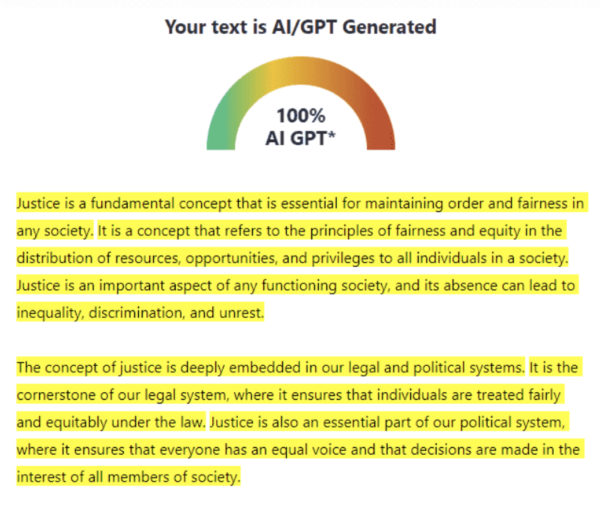
Trial verdict: Court is back in session. Please be seated. Based on the evidence provided, it is the judgment of this Court and its jury that the defendants are not guilty. A critical truth that the argument failed to acknowledge is that artificial intelligence itself is trained on the brilliance of human writing. In fact, the very examples pointed out before—namely the em dash, Oxford comma, correlative conjunction, and extensive vocabulary—haven’t originated from this machine, but rather humans themselves. If AI is able to write with such precision, elegance, and ingenuity, it is only because humanity was able to do so first. Thus, the evidence provided before this Court only serves to prove these students’ capability in generating the brilliance that AI attempts to imitate. Case closed.