

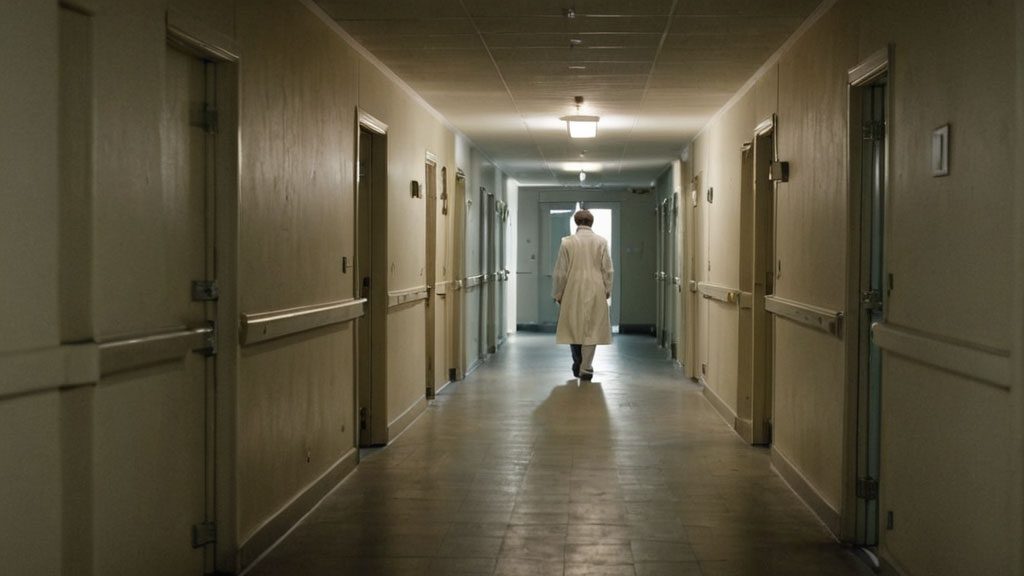
Doors removed from bathrooms and bedrooms. Artwork banned from the walls. Multiple security stops before visitors are allowed to enter. Recently, psychiatric hospitals have begun to resemble prisons more than places of healing. On paper, psychiatric hospitals are specialized medical facilities that provide inpatient (in person) care for individuals with severe mental health disorders such as schizophrenia, bipolar disorder, and acute depression. However, in practice, many psychiatric hospitals prioritize control and liability over long-term recovery, creating an environment that lacks empathy towards patients.
In one study, 65% of psychiatric patients reported being handcuffed and transported in a police car, 29% said they were physically “taken down” by police or staff, 34% were restrained, and 59% were placed in seclusion (Frueh, 2005). In another, patients reported the patronizing and even abusive ways staff had treated them—threatened, neglected, taken advantage of, and regarded as if their illnesses made them childlike, irrational, and incapable of grasping their own needs. It is ironic to think that the institutions created to treat those with mental health conditions are sometimes actively exacerbating their illnesses.
The roots of this problem stem from the 1960s, during the height of the deinstitutionalization era—a social movement that sought to move people with serious mental illnesses out of large state psychiatric hospitals and into community-based care, such as outpatient therapy clinics, mental health centers, and supportive housing programs. Fueled by outrage over inhumane treatment, optimism about new psychiatric medications, and economic incentives, deinstitutionalization enabled the mass reduction in state hospital populations—but not without a cost. Unfortunately, this movement did little to significantly improve the conditions psychiatric patients were living in. According to a study from 2013 reported by Daniel Yohanna, MD in the AMA Journal of Ethics, after deinstitutionalization, “People with severe mental illness [could] still be found in deplorable environments, medications [had] not successfully improved function in all patients… and the institutional closings [had] deluged underfunded community services with new populations they were ill-equipped to handle.” In fact, by removing them from state-funded psychiatric hospitals that previously provided long-term care, sometimes spanning for decades, patients now found themselves being transinstitutionalized rather than deinstitutionalized—shifting them from hospitals to nursing homes, jails, and shelters. The result was widespread homelessness, increased incarceration among the mentally ill, and little progress toward the movement’s original goals of humane, effective care.
Today’s psychiatric system reflects the consequences of that failure. The system fails because it has been forced to become one that prioritizes solving crises over promoting recovery—a phenomenon researchers refer to as “revolving-door psychiatry”. Characterized by short inpatient stays and frequently re-admitting patients due to insufficient care during hospitalization, revolving-door psychiatry often traps patients in a cycle of admission, medication, discharge, and relapse. Additionally, another study reported by Matthew L. Edwards, MD and Nathaniel P. Morris, MD in the AMA Journal of Ethics notes that as psychiatric institutions have shifted toward crisis aversion rather than long-term treatment, they have “coincided with increased clinical and legal emphasis on… downward pressures toward sparser, controlling environments—what we refer to as the safety funnel.” In other words, psychiatric hospitals are now designed more to contain risk than to promote healing, pressuring psychiatric staff to prioritize nullifying potential risks over addressing the therapeutic needs of their patients. These efforts often compromise a patient’s dignity, privacy, and humanity, creating the sparse, controlling, and, in some cases, outright harmful environments within these institutions today. It is undeniable that if psychiatric hospitals are to truly serve as places of recovery, this system must be reimagined. Yet, in striving to protect patients’ dignity, we also face a complicated but unavoidable dilemma: How do we balance creating a risk-free environment that ensures the safety of the patients without breaching their autonomy?
It is critical to recognize that the ethical tension between safety and humanity lies at the center of this issue. Not only must staff consider both the need to reduce risks of patients hurting themselves or others, but also the responsibility to preserve patients’ dignity and autonomy—something that often fails to be upheld by today’s system. Without question, it is inhumane for patients to be subjected to physical, sexual, and mental abuse in the facilities they came to to heal. Measures such as solitary confinement, forced medication, and excessive use of restraints violate the patients’ rights and must be mitigated. However, it is equally as important to intervene when a patient perpetuates self-harming behaviors whenever they are unsupervised. This tension exemplifies a fine line between balancing the safety of the patient and breaching the patient’s privacy, humanity, and dignity—yet it may also point toward a path to solution. Open discussion of where this line should be drawn may be the key to reforming psychiatric care. Ultimately, protecting patients from harm should never come at the expense of their dignity, and until the system acknowledges both needs as equally vital, psychiatric care will remain broken.